

How much time have you spent staring at an empty mailbox after applying to numerous positions? “We’d like to confirm we’ve received your application…” and then… silence. Even an automatic rejection would have been more bearable.

You’ve done everything right. You have relevant experience, a matching skill set, a well-maintained GitHub portfolio. You’ve spent hours perfecting your CV – it’s clean, readable, and concise. You’re actually overqualified for the position and definitely not asking too much in terms of compensation. They should at least give you a chance. Yet, silence is the only – and all too familiar – response.
Self-doubt starts to creep in:
– Maybe I’m not that good?
– Maybe I’ve been lucky so far in my career?
– Maybe the market is flooded with developers who are better/younger/more experienced than me?
Anger quickly follows:
– Is this what I get for sacrificing 8 years of my life?
Trust me, everyone who lost a job in the last 2-3 years has experienced this. The good news? You’re not invisible – your CV simply hasn’t been tailored to pass the gatekeeper: the ATS.
In this blog post, I’ll show you how to create a CV that gets past that first hurdle. We’ll cover which sections to include, the best order to present them, effective phrasing techniques, and how to tailor your CV to match job postings for maximum impact. So, without further ado, let’s dive in!
Knowing the “enemy”
In order to defeat the enemy, you need to know them first. So, what is this mysterious gatekeeper standing between you and an interview? Before I answer, let’s look at this situation from another perspective – the HR’s or hiring manager’s.
Let’s imagine you’ve just posted a job offer at LinkedIn. Can you guess how many candidates have applied within the first 15 minutes? 10? 50? 100? The number is usually in the hundreds. And I’d use the term “candidates” loosely… Most of the applications are made by bots, spamming the recruiter’s systems with fake or inflated CVs. An established company may receive up to a 1000 CVs on a single opening. Now, multiply it by the number of opened positions. Good luck filtering it out manually…
A solution, as with everything these days, came in the form of the AI-powered Applicant Tracking System (ATS). In a nutshell, it parses the CV, analyses it, verifies it against available data sources (like your Github and LinkedIn profiles), summarizes it, and assigns a score calculated for a give job specification. In the end of the day, only the CVs with score above 90 have chances to be recommended to the hiring team.
Does this sound harsh? Dehumanizing? Because it is… yet, it’s also an effective solution to a widespread problem facing IT companies these days.
Fortunately, ATS systems are quite predictable. Like any AI-based tool, you can reliably anticipate results if you understand its instructions, prompt(s), and control the input data. Of course, nothing with AI is guaranteed. You might submit a CV that perfectly matches both the job description and company culture yet still not get selected.
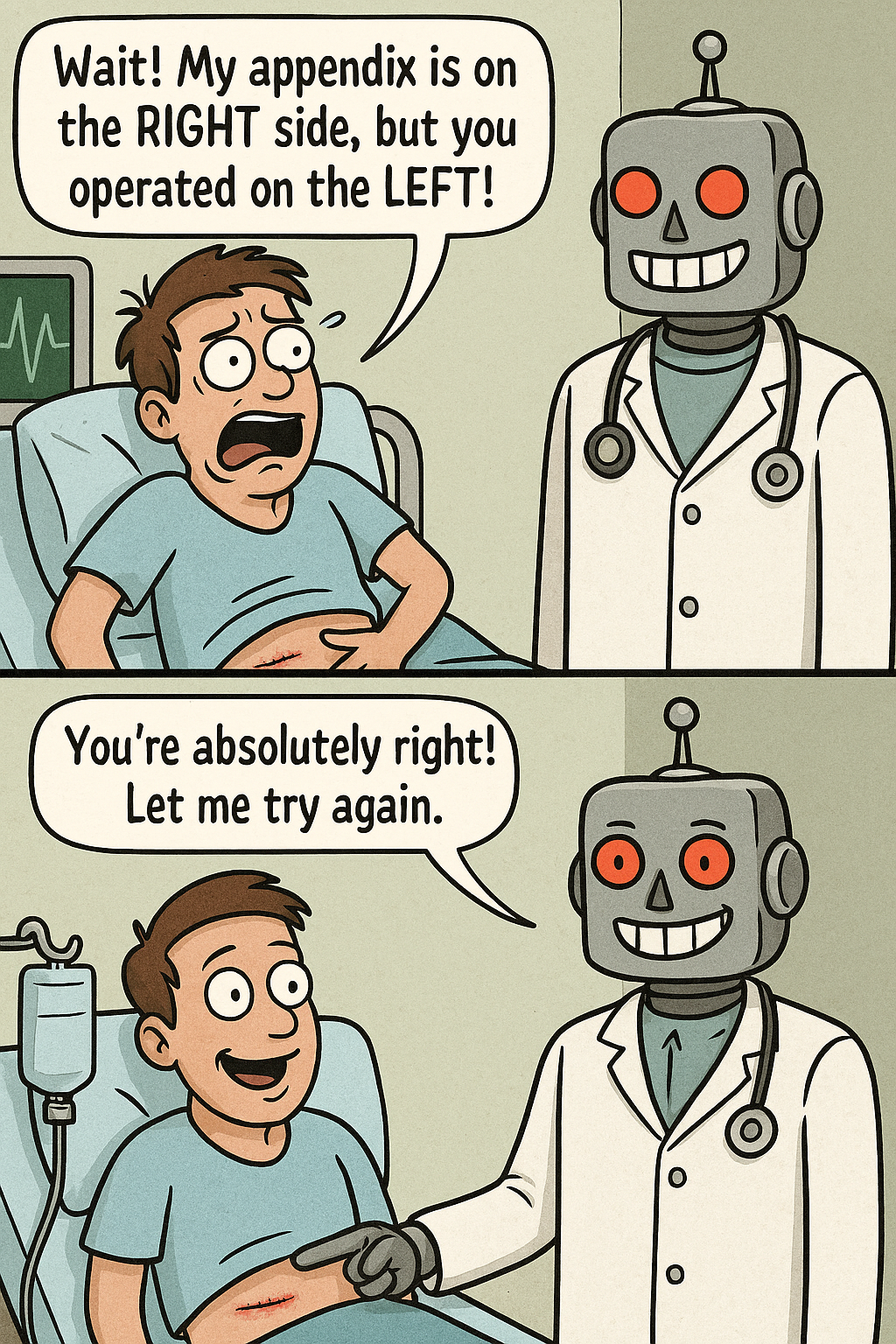
Nevertheless, most ATS systems follow certain common rules when evaluating candidates. Let’s examine these together.
Rule #1: Structure your CV in ATS-friendly way
Have you ever fed an AI tool a PDF with complex formatting, rich graphics, or tables? Was the extracted content readable? Probably not. ATS works the same way. To assess your CV, it first needs to understand it. This becomes difficult when your skills are scattered throughout the document.
The golden rule is that your CV should read vertically, with clearly separated sections and distinct headers. Avoid using complicated layouts. They look great when read by human, but, as we establish, your first goal should be to get your CV past the ATS.
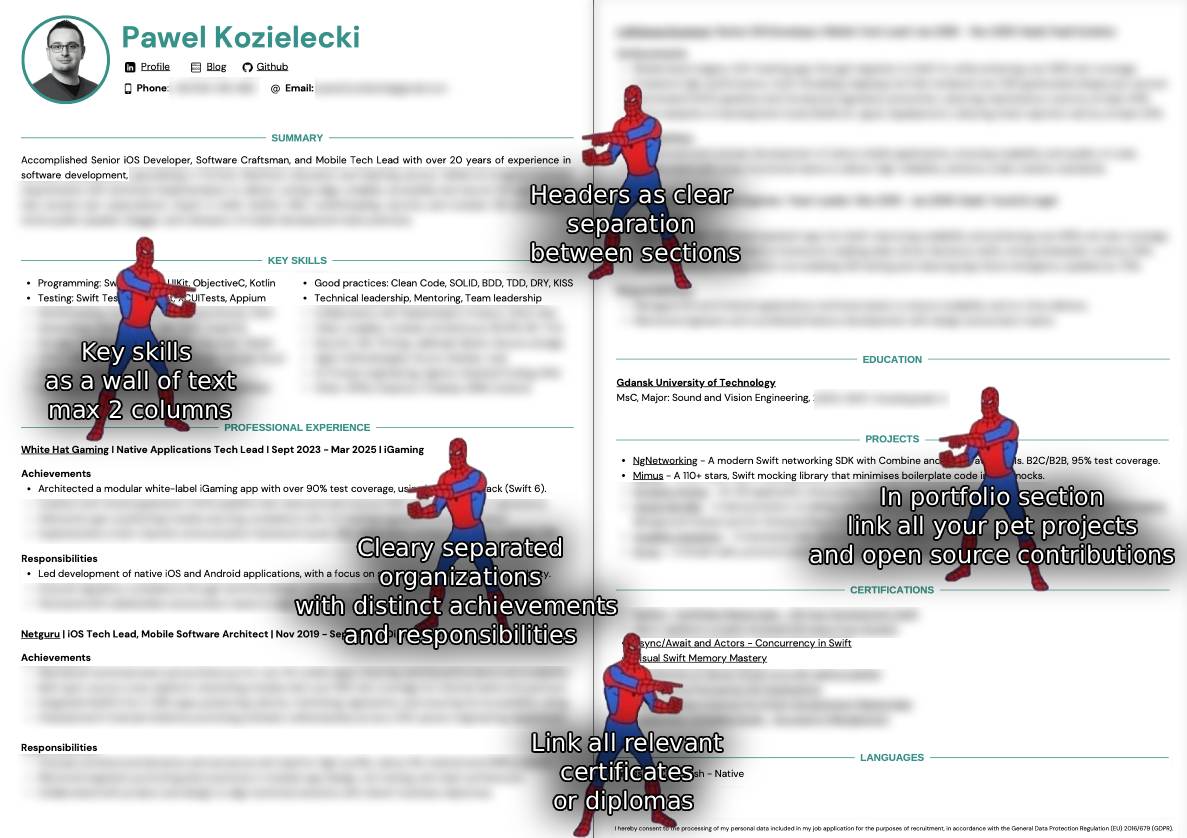
Equally important is to present everything as text. Avoid using graphical symbols, images, ascii art, etc. Please don’t visualize your SwiftUI proficiency as a progress bar… Additionally, you can consider removing your profile picture. A pictureless CV is actually preferred by some companies as it helps mitigate bias. Not to mention helping the ATS do its job better!
To verify if your CV is truly ATS-friendly, upload it to any AI chat and ask some control questions: Can you extract the main CV sections cleanly? Are they readable? Are any key sections missing? Are the headers prominent enough? What are my team-building skills? etc. **Only when you’re certain an AI chat can effortlessly process your CV should you start tailoring it to specific job listings.
Now that we’ve covered the basics, you might be wondering: What tool should I use to build such a CV? You might suspect that traditional word processors like Pages or Google Docs aren’t ideal for this purpose. And you’d be right. So what’s the alternative?
Commercial CV building sites often claim they can effortlessly create ATS-compliant CVs. While this might be true, they typically offer only a limited number of rigid CV templates. These were primarily designed to look visually appealing rather than to be ATS-friendly. The ATS doesn’t care about how beautiful your CV is – it’s only interested in the volume and quality of the content. Trust me: it’s very difficult to fit all necessary information into a predefined, rigid template…
What tools can I recommend? I personally use Canva, which is free as long as you avoid premium elements. It offers a clean, intuitive UI and, most importantly, generates PDF files that ATS tools can easily read. Canva isn’t perfect, though. As a design tool, it’s not built for handling large amounts of structured text. Unlike word processors, it won’t automatically adjust text sections when you change page margins. It also lacks free ATS-friendly CV templates. However, this is easily remedied – feel free to use the template I created for my own CV.
Rule #2: Master your professional introduction.
Research shows that in face-to-face meetings, you have approximately 7 seconds to make a good first impression. Anything we do afterward is likely to reinforce the initial perception a person has already formed of us.
The same principle applies in the ATS-driven world of IT recruitment. Your professional introduction will likely be the first section an AI system analyzes when parsing your CV. It’s very likely it’ll use it to formulate an opinion about you. Its importance cannot be overstated.
So what should your introduction section contain? I’d roughly divide it into 2 parts:
- “About me” section:
Think of it as a classic elevator pitch: who you are, what you do, and what you excel at. You should start with a single sentence best describing who you are:Senior iOS Developer, specializing in SwiftUI and reactive programming or Experienced mobile Team Leader with over 10 years of experience.Follow it up with a brief summary of your experience, industry sectors and organizations you worked for, areas of expertise, etc. The trick is to treat this as a template that you may adjust for each job application. Just a word of caution: don’t overdo it – the ATS still needs a clear picture of who you are. For example, if you’re applying for a Senior Mobile Developer position at a FinTech startup, you might highlight your 5 years of development experience at a large bank or your contributions to relevant open-source projects. - “How can I benefit you” section:
This part is where you highlight all the contributions you could make if selected. Read carefully what the company is looking for. If they emphasize working closely with designers and product owners, you can mention that you areAdept at bridging business requirements with technical implementation. Likewise, if they value testable and scalable code, you might add:Software craftsman, S.O.L.I.D. engineer dedicated to creating robust and scalable apps. The more boxes you tick, the more likely the algorithm will highlight your CV. Again, be sensible here and don’t overdo it. If you blindly copy-paste phrases from the job advert, the ATS will likely detect this and downgrade your score. Aim to be a great fit, but not suspiciously perfect!

Knowing all that, let’s write an introduction section for Mark – a Senior iOS Dev with 5 years of experience. He started at a med-tech startup, working on an SDK connecting with Bluetooth wearables. Unfortunately, the startup failed, so Mark had to look for a new opportunity. This came in an unexpected form – becoming a military contractor. When it comes to anything military-related, security is paramount. As Mark found this topic fascinating, he joined a team developing a secure communication app used in the army. He quickly became an expert in the field. Additionally, he developed strong business acumen, as he often had to explain and promote his ideas directly to military representatives.
Imagine Mark wants to join a team that develops a personal banking assistant app. Here’s how an effective introduction for his CV might look:
Dedicated, result-driven Senior iOS Developer with 5 years of hands-on experience designing and building secure and reliable mobile applications, specializing in security-focused solutions and Bluetooth Low Energy (BLE) integrations. (About me section) Proven track record in delivering robust iOS apps within the highly regulated military and medtech sectors. Strong collaborator, skilled at translating business needs into effective technical solutions that meet strict security and compliance requirements. (How can I benefit you section) Passionate about mobile security and staying current with evolving iOS technologies. (About me section continues)
This is just one example, of course. Don’t hesitate to experiment with different keywords, skill emphases, and varying proportions between these two main sections to find what works best for your specific situation.
Rule #3: Tailor your skills to the job requirements.
Imagine you’re tasked with reviewing a stack of anonymous CVs. How would you select candidates to recommend? You’d likely check their skills and experience to see if they match the advertised role, right?
ATS systems work the same way. They scan for the Skills section in your CV and extract keywords to create a profile of your capabilities. This profile is then cross-referenced with the job description.
In simple terms: the ATS is trying to answer one question:

So, how do you go about creating a comprehensive Skills section in your CV? Just follow these 4 rules:
- Structure the section clearly:
ATS prefers clear, distinct sections that read naturally – from left to right, top to bottom. Ensure your skills section has at most 2 columns with clear separation between them. A good practice is to put hard skills, like programming languages, persistence frameworks, etc., in one column, and softer skills, like technical leadership, team building, etc., in the other. Naturally, we assume your CV is in English and you are applying to an English-speaking company. Honestly, I don’t know how the ATS parses texts that read from top to bottom… - Use clear, textual descriptions:
As you should have figured out by now, ATS is good with processing text. And only text. Please, do not include any graphical indicators, progress bars, etc. to visualize your level of proficiency in a given skill. ATS is unlikely to comprehend it, even if you use ASCII. Better yet, get rid of all skill proficiency indicators altogether. Phrases like Swift: Expert will likely not help your case. If you include a particular skill in this section, it’s assumed you’ve mastered it at least to a professional level. - Provide additional context:
Whenever working with AI, context is paramount! You’re likely to get totally different responses if you provide an LLM with a proper setting for your questions. It’s the same with your skills. Although it might sound excessive, it’s really worth carving out some space to signify what area your skills belong to, e.g.Programming: Swift, SwiftUI, UIKit, ObjectiveC, Kotlin or Good practices: Clean Code, SOLID, BDD, TDD, DRY, KISS. - Emphasize skills mentioned in the job advertisement:
This point cannot be overstated. The ATS is limited in its reasoning capabilities. For example, if you’ve includedRelational Databasesas a skill in your CV, it might not recognize that you’re proficient withCore DataorSwift Data. Especially since neither is technically a database, but rather a form of persistence graph… Technicalities aside, it’s worth copying some phrases directly from the job advertisement, particularly those listed as mandatory requirements. However, as with other aspects of your application, don’t aim for perfection. ATS systems can likely detect CVs that are nearly verbatim copies of the skills listed in the job posting. Instead, try adding relevant skills beyond those specifically required for the position. You might also experiment with generalizing certain skills descriptions. E.g., rather than listing every analytics client you’ve implemented in your apps, you could use more generic phrase:User Tracking and Experiments: Analytics, A/B Tests, Remote Configuration. - Do not cheat!
At this moment you might be tempted to enrich your CV by adding skills you don’t yet have or technologies that are still on your to-do list. I strongly advise against this. First, sophisticated ATS systems can cross-reference your skills with your actual job experience, GitHub, LinkedIn profile, and open-source contributions. If your claimed skills aren’t backed up by your work history or external sources of truth, your score may be downgraded. We’ll dwell deeply into this topic later. Second, even if you get past the ATS, you’ll still need to prove your skills during the technical interview. Trust me – experienced teams can easily detect whether you’ve actually worked with a specific technology, programming language, or framework. What should you do instead? Be honest. If you haven’t usedGRDBin a project, don’t mention it. If you’ve used other databases or persistence frameworks likeSQLite, list those instead. Missing one specific skill is rarely a dealbreaker, especially if you’ve mastered related satellite skills or frameworks. Finally, if you lack experience in a particular area, but are eager to learn, simply state this in your CV:Currently Learning: Swift Data, Observation, ...Better yet, start a pet project to experiment with these technologies and include a link to it in your CV.
As in the previous section, let’s look at a real-life example. This time, we’ll explore Adam’s CV. Adam is a junior iOS Developer applying for a Regular Dev position at a software house. This company values general knowledge of the iOS ecosystem over specialization in one area like architecture. Additionally, they prioritize attitude over aptitude, actively helping developers grow and advance. The sample skills section in Adam’s CV might look like:
Programming: Swift, SwiftUI Networking: REST, URLSession, JSON parsing Storage: UserDefaults, Keychain Version Control: Git, GitHub Reactive programming: Introduction to Combine Teamwork: Pair programming, Code reviews Architecture: MVVM, MV Agile methodologies: Scrum, Kanban Other: APNS, Firebase Analytics and Remote Configuration Currently learning: CI/CD, Test-Driven Development, async/await
Feel free to arrange these skill categories / groups as you see fit. If you are more experienced, don’t forget to mention leadership and team building skills, etc.
The primary goal, as discussed, is to provide the ATS with as much context as possible to properly evaluate your skils.
Rule #4: Craft compelling job experience descriptions for maximum impact.
Now that you’ve created a comprehensive Skills section for your CV, what’s next? Let’s continue following the ATS logic. The system now knows you claim to have skills that match the job description. The next question it tries to answer is: Are these skills reflected in the candidate’s job experience? In other words: Has the candidate had opportunities to apply these required skills in practice, and have they made any meaningful impact while doing so?
Fortunately, there’s a simple formula to craft a powerful Professional Experience section. Let’s take a look:
- Clearly separate organisations you worked for:
As we discussed, ATS loves clarity. The worst thing you can do is to allow it to blend together different roles and organisations. Fortunately, we can prevent that from happening by distinguishing each role with a clear sub-header. Such header should contain organisation name (linking to their homepage), your role, timeframe, and nature of their business, e.g.:Netguru | iOS Tech Lead, Mobile Software Architect | Nov 2019 - Sept 2023 | Digital Agency. - Show how you’ve made an impact:
I cannot stress this enough: achievements without metrics ring empty! You must attach clear and measurable outcomes that your work produced! This approach benefits you twofold: it backs up your skills and proves that you are results-oriented. E.g. instead of writing:Worked on the SDK to securely connect with BT LE devicestry:Enhanced SDK with secure connection with iBeacon device over Bluetooth Low Energy, raising overall test coverage by 11%. The metric you choose doesn’t have to be about code quality. E.g.: the number of new users the app onboarded thanks to your changes, the amount of time saved through the onboarding process you helped implement, or the conversion rates that improved due to your contributions will serve equally well . Whenever in doubt, look into analytics for relevant data. The only true challenge here is to make sure each achievement fits into a single line. - Showcase your responsibilities:
After showing your impact, now it’s time to highlight what you were responsible for. Sounds easy, right? Just find your old contract and copy-paste the proper section? Well, I would advise against that… You see, as we discussed, ATS loves numbers. Even your responsibilities should be quantifiable. Instead of using cliche:Collaborated with cross-functional teams to deliver reliable mobile apps
try:Collaborated with cross-functional teams to deliver high-reliability solutions under XYZ aviation standard. Mentioning e.g. which industry standards you had to uphold while performing your duties instantly elevates your scoring with the ATS. - Focus on your latest jobs:
Let’s be honest – few people are interested in what you’ve been doing 7 years ago. If you’ve been in the industry long enough, you might find it challenging to fit all your experience into a CV. My word of advice: if it’s been more than 10 years ago, don’t include it. You can always mention these omitted projects during the interview. Also, for your 2 most recent jobs, ensure enough space to cover 3-4 bullet points describing your achievements + 3 bullet points describing your responsibilities. For all the older projects, it’s okay to reduce this to 3 and 2 bullet points respectively. - Don’t shoot yourself in the foot:
I hope it goes without saying: don’t mention anything that can potentially hurt your chances. If you resigned / was let go from an organisation after 1-3 months, simply remove this episode from your CV. Or label it as consultation or a gig. Be careful though – IT world is very small… Even if you get past the ATS screening, IT recruiters might want to dig deeper into your consulting and will likely find out what really happened.
To illustrate all the points above, let’s examine Martha’s CV. She’s an experienced iOS Tech Lead who built her career in the aviation industry. She’s seeking a tech leadership role that requires less travel while ideally remaining in the same industry. Her Professional Experience section might look like this:
My Flight Inc. | Senior iOS Developer | Jan 2015 - Dec 2020 | Aviation
Achievements
Created a high-performance, multi-threading, vector map tool that rendered over 500 geolocated shapes per second.Automated CI/CD pipelines and introduced regression prevention, reducing maintenance costs by at least 30%.Drove adoption of development tools (SwiftLint, ngrok, AppSpector), reducing ticket rejection rate by at least 20%.
Responsibilities
Architected and oversaw development of native mobile applications, ensuring scalability and quality of code.Collaborated with cross-functional teams to deliver high-reliability solutions under aviation standards.
Rule #5: Sweetening the pot - your accomplishments outside of work
Now that we’ve covered your Introduction, Skills, and Professional Experience sections, the ATS should be able to assess you as a good fit for the role. It’s time to sweeten the pot by adding your other accomplishments.
Why is this important? Think of it as a distinguishing factor that elevates you above other candidates. It’s particularly valuable when job advertisements mention they’re seeking candidates with passion for learning or who continuously hone their craft – phrases found in nearly 99% of job postings. Highlighting that you’ve earned certifications, contributed to open-source projects, or developed your own applications clearly demonstrates that you’re willing to invest personal time and effort into self-improvement. And major ATS LLMs are trained to pick up on that.
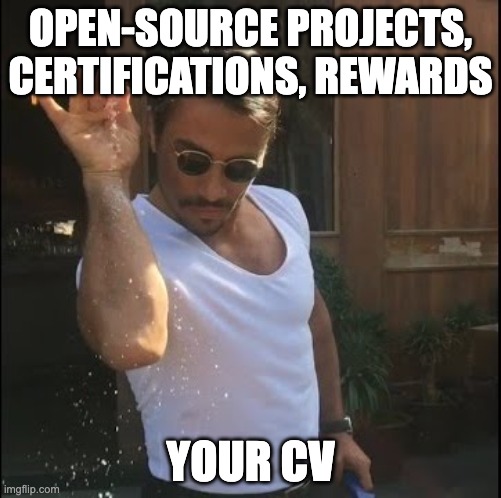
So, what’s worth including in this section? I’ve decided to divide it into Projects and Certifications. It’s also perfectly fine to create dedicated sections for your work as a mentor, volunteer activities, participation in community initiatives, etc. However, I would avoid mentioning politically sensitive engagements.
Let’s go through each contribution worth adding:
- Open-source contribution:
Describe what this project is and make sure to link to it – ATS loves links. As always, it’d be good if you could work some metrics into the description, e.g. test coverage, amount of stars the project has on Github, etc.:NgNetworking - A modern Swift networking SDK with Combine and async/await APIs. B2C/B2B, 95% test coverage. - Pet projects:
Likewise, create a clear, concise description of each personal project you’ve worked on. The project doesn’t need to be perfect, complete, or even particularly useful. It could be as simple as a playground demonstrating a creative approach to solving popular matching brackets DSA problem. The key is to invest time in crafting a good project description, selecting appropriate tags, and creating a thoroughReadmefile on GitHub. The ATS will likely parse this text to find out more information about the project. Let’s take the Asset Bundler as an example – a sample app showcasing the Background Assets framework for seamlessly fetching mobile game content:Assets Bundler - A demonstration of adding dynamically downloadable content to an iOS application by leveraging Background Assets and On-Demand Resources. - Certifications and awards:
Certificates, higher education diplomas, and scientific degrees are a polarizing subject. Some argue that our field evolves so rapidly that even the most prestigious degree becomes outdated the moment a person steps out of the university. On the other hand, people invest significant time, effort, and often substantial money to earn these credentials. They should be rightfully proud of their achievements. The truth, as always, lies in the middle. Yes, academic knowledge gets outdated quickly, but it also demonstrates a candidate’s willingness to learn – especially certifications obtained after graduation. If you have relevant, publicly available certifications, you should definitely include them in your CV. Being honest though, the days when certifications alone could secure you a well-paid position in top IT organizations are long gone. This is why this section is usually placed closer to the bottom of the CV. As icing on the cake rather than a main dish. How to include this information in your CV in an ATS-friendly way? At this point you know the drill – craft an interesting and concise description and link the actual certificate or diploma so that the ATS can follow it, e.g.:SwiftUI + SwiftData Masterclass - iOS App Development Swift. - Books, Blog posts and similar publications:
If you have any interesting books, blog posts or articles you’ve contributed to, be sure to include them as well. As always, the ATS doesn’t care if your articles are popular or if the book you’ve published is free and only 20 pages long. What matters is that you made the effort to publish them and that you’re comfortable exposing your work to criticism. I personally don’t include individual posts or articles, but instead link to a page on my blog that aggregates all my published work. This way, the ATS can crawl through all the publications if it’s programmed to do so. - Conference or meetup presentations:
If you’ve spoken at industry events, include them here. Again, it doesn’t matter how big or prestigious the meetup or conference really is. What matters is your willingness to step up, prepare a presentation, and share knowledge with the community. Usually, organizers publish videos, event summaries, or at least slide decks sometime after the event. Be sure to link to these resources if possible. - What else should I include?
The rule of thumb is: if it’s relevant, not controversial, and enhances the professional image you want to project – include it. Have you won a hackathon, promoted a business idea that generated significant revenue for a company, or organized a charity event? All these accomplishments can elevate your profile, as long as they align with the core values of the company you’re applying to.
Assessing Your Progress - Using AI to Evaluate Your ATS Score
We’ve come quite a long way together – from understanding what ATS is to composing entire CV to its liking. However, this section will be equally important, as we are missing one key component – the feedback.
In the old days, one could ask a friendly designer or HR to grill a CV. In times of ATS-driven recruitment such a feedback would not help us too much. So, what should we do? Play sleak uno-reverse card on the ATS and ask other LLM to validate your CV and calculate ATS score!
Embrace the the following cycle:
- Upload your CV to multiple LLM tools for validation:
Most LLMs provide document upload capabilities. For best results, consider using a paid subscription like ChatGPT Pro. These premium services not only give you access to more sophisticated models but also offer enhanced privacy protection for your personal information. When creating your prompt, always include the job listing URL, the position you’re targeting, and your CV. Try multiple LLMs to get different ATS scores – you might be surprised by the variation. If you receive a very low score or the system can’t determine one, it usually indicates your CV isn’t structured in an ATS-friendly format. In this case, revisit your CV’s structure, font choice, and spacing between sections, etc. Personally, I rely on Perplexity for ATS score calculation. It’s designed to parse web information (including PDF documents) and compare different sources, making it ideal for this purpose. I typically use this simple prompt:Analyse the attached CV against the following Senior iOS Developer position: [link] and rate its ATS score in scale 1-100. - Ask the LLM for specific improvement suggestions:
After receiving a score, request detailed improvement recommendations from the LLM. However, approach these suggestions critically. Interestingly, the higher your initial score, the more likely that implementing the LLM’s proposals might actually decrease it. This is why I recommend consulting multiple LLMs for different perspectives. ChatGPT might catch issues that Claude missed, and vice versa. A sample prompt could go like this:Suggest improvements to my CV that would allow me to achieve ATS score of at least 94 points. - Apply these suggestions and generate an updated CV:
Having analyzed the improvement suggestions, prioritize them based on difficulty to implement. Then, select only 1-2 recommendations, implement them, generate a new CV, and upload it to your LLM of choice. Why limit the number of implemented changes? Because you don’t really know which CV modifications affect the ATS score the most – especially negatively. If you implement 5 changes at once, 4 might have a positive impact raising your score by 4 points, while the final one could have a negative impact of 3 points. Although you’ve improved your CV’s overall score, you’ve missed an opportunity to make it even higher. - Repeat this process until your ATS rating exceeds 90.
I’m going to be brutally honest here – don’t bother sending a CV that has an ATS score below 90 points. Given how saturated the IT job market is, and how many great specialists are actively looking for work, you need to make extra effort to tailor your CV to the job advertisement and the organization that posted it. Ideally, rinse and repeat points 1-3 until you’ve reached a 94-95 ATS score. Don’t fall into the perfection trap. Reaching 95+ ATS score is a game of diminishing returns. You’re likely to spend 5x more time improving your CV’s score from 94 to 96 points than going from 90 to 94 points. Also, too perfect a fit might actually flag your CV as suspicious to the actual ATS.
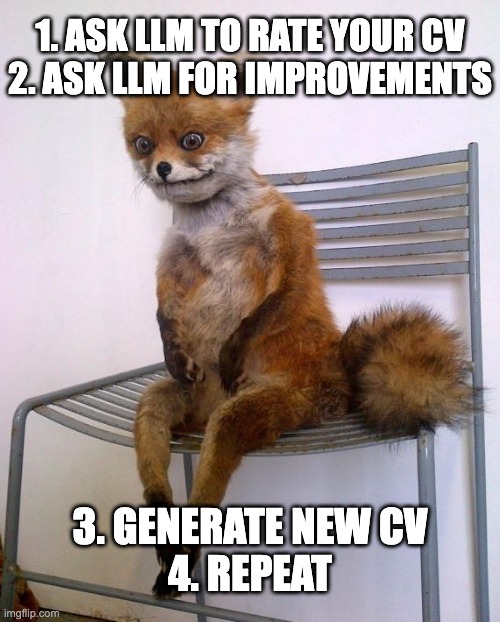
So, have we reached the point where you can finally click that big, red button labeled: Apply? Almost…
Final touches - make sure your public profile matches the CV
Claiming to have contributed to many open-source projects but your GitHub doesn’t reflect that? Stating you worked for a Fortune 500 company but your LinkedIn doesn’t mention it? Saying you have a blog but the link doesn’t exist? These are just a few examples of inconsistencies that can significantly lower your ATS score.
Let’s be honest – it would be naive to expect top ATS systems not to be programmed to verify candidates’ CVs against publicly available sources like GitHub and LinkedIn. Of course, projects you worked on might be private, or you might no longer have access to them. Companies (especially startups) go bankrupt or get acquired. There are many valid reasons why a candidate cannot definitively prove their CV is 100% legitimate. And I expect ATS systems don’t treat such a lack of confirmation as highly problematic. What they look for, however, are red flags: different job titles or positions missing from your LinkedIn profile, an empty GitHub account or no GitHub profile at all, etc. If such inconsistencies are detected, your CV will likely be flagged. Even if you pass the initial selection, you’ll probably be asked about these discrepancies during the screening call.
Here are a couple of ideas you might consider to minimize risks of any red flags being raised:
- Ensure your LinkedIn profile matches your CV:
LinkedIn profile should be treated as an extended CV. Use it to showcase information too extensive for your resume: projects, rewards, recognitions, and collaborations. Include your complete professional history – from internship to your current position. While no one wants to read a 5-page CV detailing your early career as a developer (or experience in an unrelated field), LinkedIn provides the perfect platform for this comprehensive information. At minimum, ensure the professional experience mentioned in your CV exactly matches your LinkedIn profile: job titles, companies, responsibilities, and achievements. It’s also helpful to add relevant skills that align with those highlighted in your CV. Even if the ATS won’t crosscheck these details, recruiters will have an easier time reaching out to you. - Polish your Github profile:
Similar to LinkedIn, make sure all your open-source libraries, pet projects, etc. are properly described in both a Readme file and within GitHub (including adding proper tags). The project description in your CV should match the one on GitHub. Even if a particular ATS system doesn’t follow links to projects, investing time in crafting detailed descriptions and tagging projects properly will significantly increase your professional visibility. It’s also worth polishing the landing page, as you’ll likely link to it in your CV. At minimum, pin your most relevant Open-Source projects to the landing page and ensure your contribution chart shows some activity. Even if you’ve been working on private repositories, you can still include that work in your contribution chart – just look up the appropriate option in your profile settings. - Enter your name in a search engine and see what pops up:
It’s easy to imagine that ATS systems might Google you and cross-reference findings with your CV. Unlike LinkedIn and GitHub, you have limited control over how third-party content (meetup summaries, conference mentions, LinkedIn posts, etc.) appears in search results. What you can do, however, is ensure your own content is properly described. If you have a blog, run it through Google’s dedicated indexing tool. This will verify if your pages have proper meta tags, are readable to bots, contain an appropriate sitemap file, and more.
Summary
Whether you like it or not, ATS is here to stay. I don’t foresee hiring teams voluntarily giving up the convenience of automatic parsing, analysis, and grading of CVs. In the near future, it’s very likely that ATS will replace the hiring teams themselves – at least initially during introductory calls. Building a voice AI agent isn’t rocket science. I’ve created a decent one myself without being an expert in the field. Is it really so far-fetched to imagine an ATS booking a meeting, introducing itself, asking standard questions (Tell us about yourself., Why our company?, What’s your power animal? etc.), inquiring about job experience and interesting projects, and following up with screening technical questions tailored from your CV? Is it really that much worse compared to a conversation with a human? I think not. In addition, ATS can be programmed to send you feedback after such a call. Shocking, I know…
Knowing the enemy is here to stay, we can learn about it and devise a battle plan. This humble guide aims to serve that very purpose. We’ve explained how the system evaluates résumés and what affects your score. We followed up with battle-tested strategies to craft applications that pass the gatekeeper: ATS-friendly CV formatting, proper Introduction sections, followed by equally comprehensive and consistent Skills and Professional Experience. Next, we further strengthened your application by including personal projects and open-source contributions, as well as relevant certifications. Finally, we emphasized the importance of maintaining consistent professional information across multiple platforms: GitHub, LinkedIn, blogs.
On a personal note, it took me approximately one month to figure out how the system works. I managed to do this in reasonable time only because my friend Kris showed me the ropes. The difference between acceptance rates of standard versus ATS-friendly CVs was truly mind-blowing. Naturally, I didn’t craft a perfect CV on the first try. Far from it. I received a fair share of rejections until I polished my template enough to get my foot in the door at most places I applied to.
If you’re job hunting, my final advice is: embrace the numbers game. There’s no shame in applying to the same company multiple times – with an updated CV, of course. There’s no shame in receiving a rejection minutes after applying either. On the contrary – that’s the best feedback you could get. Go back to your CV, adjust it to the job listing, recalculate your score, and apply again. This is the only way forward.
Don’t miss any new blogposts!
By subscribing, you agree with our privacy policy and our terms and conditions.
Disclaimer: All memes used in the post were made for fun and educational purposes only
They were not meant to offend anyone
All copyrights belong to their respective owners
The thumbnail was generated with text2image
Some images were generated using Leonardo AI
Audio version generated with TTS Maker


